 This evening I finally got round to seeing No Age perform after two years of listening to them and multiple missed opportunities during their previous UK tours. This however was not an ordinary gig; held at the ICA, the event consisted of the band performing a live soundtrack to Jean-Jacques Annaud's 1988 film The Bear, which follows an orphaned bear cub who befriends an older, male grizzly bear who has been wounded by hunters, and charts their companionship and attempts to avoid the guns of the two hunters. It provided a more than suitable back drop to the sounds coming from below the screen, No Age's instrumental improvisation allowing you to to sit back and lose yourself in the narrative of the - at times quite poignant - film. Playing continuously for the length of the film it was akin to album tracks such as Impossible Bouquet or Escarpment, the guitars and electronics at time melodic and at others crashing down, with walls of distortion and drums used to heighten the tension at certain moments throughout the film. Managing to avoid both repetitiveness and overbearing the film, their understated playing style, doing a lot with not a lot, turned this marriage of music and film into a pretty successful one in my opinion. Perhaps more No Age film scores are needed?
Showing posts with label Film. Show all posts
Showing posts with label Film. Show all posts
Sunday, 3 April 2011
No Age presents
This evening I finally got round to seeing No Age perform after two years of listening to them and multiple missed opportunities during their previous UK tours. This however was not an ordinary gig; held at the ICA, the event consisted of the band performing a live soundtrack to Jean-Jacques Annaud's 1988 film The Bear, which follows an orphaned bear cub who befriends an older, male grizzly bear who has been wounded by hunters, and charts their companionship and attempts to avoid the guns of the two hunters. It provided a more than suitable back drop to the sounds coming from below the screen, No Age's instrumental improvisation allowing you to to sit back and lose yourself in the narrative of the - at times quite poignant - film. Playing continuously for the length of the film it was akin to album tracks such as Impossible Bouquet or Escarpment, the guitars and electronics at time melodic and at others crashing down, with walls of distortion and drums used to heighten the tension at certain moments throughout the film. Managing to avoid both repetitiveness and overbearing the film, their understated playing style, doing a lot with not a lot, turned this marriage of music and film into a pretty successful one in my opinion. Perhaps more No Age film scores are needed?

Thursday, 3 March 2011
The best mind of our generation?

Last week saw the release of Howl, a film about the obscenity trial surrounding the release of Allen Ginsberg's poem of the same name in 1957, and the latest venture by actor and now general all round renaissance man James Franco. Dulcie and I went to see it at the Cornerhouse, and though I was apprehensive at first, we both really enjoyed the eclectic mix of animation and poetry recital recreations. It seems Franco has come a long way since portraying the son of Spiderman's arch nemesis; in the past year alone Franco has been Academy Award nominated for one of his numerous film roles, released a book of short stories, as well as entering the art world with gallery shows in Berlin and Beverly Hills, the latter a collaboration with Gus Vant Sant, who he worked with on the film Milk, at no less than the monolith that is Gagosian Gallery. In fact, his wikipedia entry labels him as 'actor, film director, screenwriter, film producer, author, painter and performance artist', as well as pointing out his current study for a Ph.D at Yale University. It seems there is nothing the man can't do.
In branching out into so many different areas of the creative industries Franco proves an interesting case. Many writers have dabbled in the film industry and actors and musicians are renowned for exchanging roles. The real question is whether they achieve any real success, and whether there acceptance is affected by their fame in a different field. Elvis Presley wasn't taking that seriously as an actor, nor Joaquin Phoenix as rapper. Today the crossover seems to be becoming a more popular phenomenon, with even Lady Gaga being heralded as a performance artist. Is Franco to be taken seriously as an artist, then, or does his rising to fame as a Hollywood actor negate any artistic offering he may wish to make as negligible, a mere vanity project? It is certainly an interesting question to consider in a world which claims to be post-canon, the boundaries of high and low long removed since the emergence of a so called postmodern age.
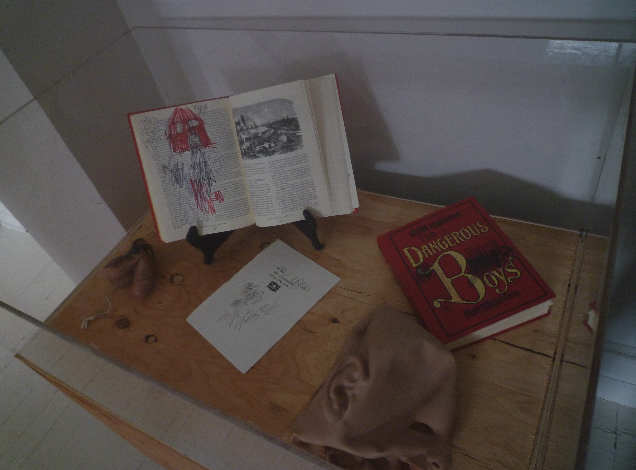


(James Franco, The Dangerous Book Four Boys, Peres Projects Berlin 2011)
Perhaps Franco is a Warhol for our times, refusing to be held down to one field or another but moving between roles with seemingly unending creative energy. Or perhaps he is simply making the most of a famous name, exhibiting at a gallery that is not shy to representing artists whose reputation often eclipses their art work - the late Dash Snow, Terence Koh, a some time Lady Gaga collaborator. Either way the fact is that he is doing these things, his book has been published, receiving not all that bad press along the way, and he is showing in the world's largest commercial art gallery. There will always be cynics, but who are we to judge? and is it ever possible to analyse art (or literature) objectively, unaffected by our knowledge of its author?
Saturday, 5 February 2011
Zidane

I finally got round to watching Douglas Gordon and Phillipe Parreno's Zidane: A 21st Century Portrait this evening. The film follows legendary footballer Zidane for the duration of a match against Villareal, with 17 cameras tracking his every move. Edited together with the varying footage and soundtracked beautifully by Mogwai, the film is first and foremost a treat to watch and at times moving. Michael Fried has discussed this film in relation to his interests in Diderot's notion of absorption, which argues that the most true form of portrait shows the subject completely absorbed in their actions, unaware of being observed. As he points out this film does that majestically, whilst also posing interesting questions due to Zidane's immediate surroundings: he is obviously aware of the magnitude of the people watching him (in the stadium but also around the world on television), yet his ability to remain absorbed completely in the task at hand never wavers. It is this aspect that I found most interesting, the way it allows us to reflect on the nature of the image today, its mass circulation and the spectacle of the sport itself, a truly global sport of which Zidane was a global icon (albeit a tragic one...)
Friday, 3 December 2010
Le Mépris


French playwright Paul Javal is hired by American producer Jack Prokosch to save his ailing production of Homer's Odyssey, where filming - directed by Fritz Lang as himself - has been halted at Cinecittà studios in Rome. Upon accepting the job Javal's life starts to mirror that of the film's hero, with the pressures of commercial constraints (embodied by Prokosch) leading to him becoming slowly estranged from his wife Camille (Brigit Bardot). As well as an examination of the collapsing marriage of the lead characters, the film can be described as being essentially about cinema, with Godard critiquing the Hollywood model and employing numerous instances of reference and self-reference - Fritz Lang being cast as himself, Godard playing the part of Lang's assistant, Bardot reading a book on Fritz Lang, and of course the obvious mirroring of Ulysses' estrangement with his wife with Javal's estrangement with Camille. The opening shot in particular draws our attention to this explicitly, in which the mechanisms of cinema are laid bare and we see Godard's camera crew filming a tracking shot of Prokosch's assistant, the camera moving ever closer to the screen before directing itself directly at the viewer, thus implicating us as viewer or spectator in the film.
Sunday, 14 November 2010
Studio notes


Should also remind anyone that's interested about my website which is now over a month old, although still a work in progress... www.jianweilim.co.uk
Friday, 5 November 2010
GODard
"Photography is truth. And cinema is truth 24 times a second"


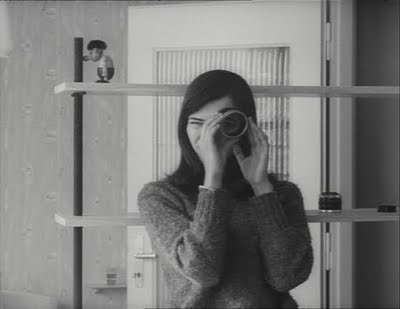


Jean-Luc Godard - Le Petit Soldat (1963)
Sunday, 20 June 2010
Somewhere soon


Have just seen the trailer for Sofia Coppola's new film, 'Somewhere'. Set in LA's infamous Chateau Marmont hotel, the plot - a disillusioned actor coming to terms with his life in the surroundings of a hotel - sounds more than vaguely similar to her cult classic Lost In Translation. Hopefully, after the somewhat hit and miss Marie Antoinette, it will be something of a return to form. The trailer also hints at some typically credible names for the soundtrack, featuring a haunting demo of You Only Live Twice from The Strokes, as well as promising music from French band Phoenix. Not sure when it's out but most certainly looking forward to it.
Tuesday, 16 March 2010
The sun is out

And I'm all done! After our fairly successful exhibition last week I finally handed in all my supporting material yesterday and it is being assessed as we speak. My final film was about 26 minutes long, played on a television screen on a loop, as the picture above rather badly demonstrates. I was pretty pleased with the results and seemed to get some positive comments about it, and had a rather bemusing conversation with a tutor about the implications of appropriating David Lynch. Right now I'm relaxing in the knowledge that every minute I sit at my laptop is now guilt free, rather than spent feeling I should really be doing something more productive. I just can't wait to get to Manchester now for the much hyped basement party part 2!
Wednesday, 24 February 2010
Summertime clothes


I processed these prints in the dark room today, my first attempt at self-processing my own photographs after successfully developing my second roll of film (the first got ruined). The pictures were taken in the Hilton Hotel in Manchester, an enormous tower of glass so thin it looks like it could blow over in the wind. We thought we'd treat ourselves to a night, and although our view from the floor to ceiling glass window wasn't quite as impressive as we'd hoped it was still a rather spectacular getaway. Particularly nice was the breakfast room, which, like Tom Ford's recent film "A Single Man", showed that the smooth curves and dark wood of sixties modernism can be stylish when it wants to be. As if all this wasn't enough we awoke to glaring sunshine pouring in through the window, giving us a rather freak day of blue skies and a shimmer of possibility that spring is actually on its way.. Though judging by the overbearing amounts of rain that has been drowning London over the past week it seems unlikely.
Since getting back to London I have managed to edit the footage I filmed the other week and have come up with a possible finished piece to show at the end of term. I also have to note that I finally finished reading Kerouac's beat odyssey "On The Road", which after two and a half years of going back and forth to feels like quite an achievement, almost as if I've been on the road with him for all that time and I've finally come to the end of the journey. Although the beats may not have been the most eloquent of writers they did know how to capture the spirit of the America of their time, and its hard to deny their influence on subsequent American culture, from Ed Ruscha's gasoline stations to Bob Dylan's Highway 61 Revisited, or Stephen Shore's Uncommon Places to pretty much every single road movie that's ever been made.
Tuesday, 2 February 2010
A film I made today
Lately I've been exploring the relationship between photography and film, and I've become increasingly interested in the gaze, or glance, and its cinematic as well as photographic effect. Last week I made a book that took one second of footage from David Lynch's Mullholland Drive and presented it as twenty-four still images, or frames. I chose the scene at first because of the way the film is deals with classic Hollywood cliches, the tragic Hollywood dream, so to speak. As I've been reading more around the subject I've been finding more and more significance within the short clip I used, which I have now remade into a film using the stills I took from the original. Edward Branigan writes that "glances are so important to narrating a story world that the only glance that is generally avoided is a glance into the lens of the camera. A look into the camera breaks the diegesis because it makes the conventional reverse shot or eyeline match impossible". What I took from this is that a glance directly into the lens of the camera breaks the suspension of reality that the audience undergoes when watching a film (specifically in a cinema, the context of the gallery space is different). This suspension of reality is important, it is the forgetting of ourself and our surroundings that allow us to be truly absorbed into the world of the film, and so a direct glance from someone on screen would remind us of the fact that we are in fact watching the film. One particular scene sprung to mind when I was thinking about this, specifically for the way it does exactly what cinematic convention says not to - the actress on screen confronts the lens directly, thus breaking the illusion the film has set up. The scene in question is from the end of Jean-Luc Godard's "A bout de Souffle":
The effect of this shot employed by Godard is quite startling, there is a sense of the absorptive experience being broken, of being addressed directly as Jean Seberg's gaze bores into the lens, before she turns her head and the film draws to a close. It is as if Godard is addressing cinematic convention, reminding us just before we leave the cinema that we are in fact in the cinema watching actors and actresses on screen. It's an aside, in the same way Shakespearean soliloquies would often address the audience directly, engaging with them so as to let them know they have an awareness of their presence. Whatever his intentions it succeeds in raising questions about the cinema and the act of viewing - the role of spectator and the sense of forgetting one submits to when watching a film.
Tuesday, 19 January 2010
An evening with Mark Leckey

Last night we turned up to our Monday Night guest lecture a few minutes later than usual, and on walking through the doors of the lecture theatre wondered why it was noticeably busier than usual. It took the sight of a rather bearded fellow at the front to realise that it was Mark Leckey, winner of the 2008 Turner Prize, that was to be speaking to us that night. I was apprehensive at first, I'd always thought Runa Islam was the deserved winner of the 2008 prize and remembered not quite engaging with Leckey's installation of films at the time. Over the course of the evening I was to be proved wrong somewhat, and actually left liking the man himself and appreciating his work in a whole new light. The talk he gave was basically a summary of his artistic career so far, from his inclusion in the New Contemporaries exhibition whilst still a student at the end of the 80s, through to the beginning of his video work using found footage, which followed a period of not making art and distancing himself from an art world he felt increasingly disillusioned with. His first notable video work, Fiorucci Made Me Hardcore, was an homage to various subcultures and the joint euphoria of music, in particular dance and rave.
He made work related to these themes for a few years, but what really interested me was a film he made in 2004 and that was displayed in his winning Turner Prize exhibition. Entitled Made in 'Eaven, it consisted of a camera panning around Jeff Koons' famous rabbit sculpture, his circling it and zooming in and out of the reflections of his empty flat. Although projected as a 16mm film you soon realise the impossibility of it - there is no reflection of a camera recording it - which reveals the true nature of the film as being completely computer generated. Mark Leckey has explained of his fascination with the sculpture that "I like the idea of something that's almost inhuman in its perfection, like Bunny. It's as if it just appeared in the world, as if Koons just imagined it and it appeared" and that is what he is attempting to address in his film, creating something tangible yet impossible. Something he talked about was his inability to fully appreciate or engage with objects in real life, he claimed he needs to see them on a screen, part of the culture of computers and the internet, which has led him not only to his investigations into the 'long tail' theory for the internet, but also, it would seem, a growing disillusionment with the art world (again) and his purpose as an artist. After a short Q & A he concluded that perhaps making a cult would be the only true form of art left. Perhaps this was a just a humourous remark to conclude the evening, but his thoughts on the art world and his ideas about the way we receive and read images left me leaving the theatre with something to think worth thinking about.
He made work related to these themes for a few years, but what really interested me was a film he made in 2004 and that was displayed in his winning Turner Prize exhibition. Entitled Made in 'Eaven, it consisted of a camera panning around Jeff Koons' famous rabbit sculpture, his circling it and zooming in and out of the reflections of his empty flat. Although projected as a 16mm film you soon realise the impossibility of it - there is no reflection of a camera recording it - which reveals the true nature of the film as being completely computer generated. Mark Leckey has explained of his fascination with the sculpture that "I like the idea of something that's almost inhuman in its perfection, like Bunny. It's as if it just appeared in the world, as if Koons just imagined it and it appeared" and that is what he is attempting to address in his film, creating something tangible yet impossible. Something he talked about was his inability to fully appreciate or engage with objects in real life, he claimed he needs to see them on a screen, part of the culture of computers and the internet, which has led him not only to his investigations into the 'long tail' theory for the internet, but also, it would seem, a growing disillusionment with the art world (again) and his purpose as an artist. After a short Q & A he concluded that perhaps making a cult would be the only true form of art left. Perhaps this was a just a humourous remark to conclude the evening, but his thoughts on the art world and his ideas about the way we receive and read images left me leaving the theatre with something to think worth thinking about.
Made In 'Eaven - a really bad clip of the film installed as a 16mm projection.
Worth reading, Mark Leckey discussing his reaction to winning the Turner Prize and thoughts on how the media receives contemporary art.
Worth reading, Mark Leckey discussing his reaction to winning the Turner Prize and thoughts on how the media receives contemporary art.
Wednesday, 13 January 2010
Still images

I'm sitting in foyles cafe, I've just had a tutorial to discuss my ideas and am contemplating my brief for the term ahead: independent exploration. Yes, that's right, an independently led (i.e. basically no timetable commitments) exploration (could it be more vague?) into my interests and impulses as a studying visual artist. As well as trying to work out what exactly to do with all this free time I have been thinking and reading a lot about the relationship between the still and moving image, the connotations of narrative and time associated with each, the idea of reliving the past in film and distilling it with photography, and somehow blurring the boundaries of both in my work. Perhaps inspired in some way by Chris Marker's La jetée and with the intention of creating some form of narrative or sense of time having passed, a suggestion of experiencing the moment, whilst at the same time exploring the connotations of a still image in various forms - a photograph, a freeze frame. Right now it's all just ideas and borrowed theories but hopefully soon I'm looking forward to the creative process once again and trying to transform these ideas into something tangible.
Subscribe to:
Posts (Atom)