Showing posts with label Art. Show all posts

Wednesday, 17 April 2013

Use value

Interesting interview here with Charles Esche, regarding the function and role of museums and the value and uses of art in present day society. He has been recently announced as curator of the 2014 Sao Paulo Biennale. Here's an excerpt that I found interesting:

Domeniek Ruyters: Why this title: The Uses of Art? It suggests that art has another dimension than some of us, used to a more autonomous interpretation of art, might think it has.

Charles Esche: Well, you know Domeniek, that we have been working on this word at VAM for quite a while. To cut a very long story short, I could say that the role of autonomy in modern art is not its role in contemporary practice. Rather than freedom of expression, it is more related to the economy of attention and how ideas gain purchase in a competitive environment. So autonomy remains a crucial concept but instead we talk about use in order to get at autonomy from another angle and, of course, we realise that some people within the world of art find that difficult.

There is also one danger of misinterpretation that people overlook the plural of uses. We are not advocating that art has only one use, but want to address its potential utility within our current ‘overcoded’ conditions (to use Brian Holmes vocabulary). We suggest that the main issue today is not the form of art as such, but much more how we engage with it, how we debate it, how it inspires us to think creatively about where we are and where we could go. Those who at the moment fetishize autonomy as something that needs to be protected make an important mistake, because they cling on to a past value without engaging it with the present tense. Often when having discussions with people who champion autonomy at the end we find that we both value exactly the same things in art, its openness, its possibility to think differently and present things we’ve never seen before. Where we part company is that we believe we should find ways to allow this openness to have agency in the present, when it can constructively manifest itself in the lives of people.

Sunday, 24 March 2013

REEL - UNREEL


Francis Alÿs - REEL - UNREEL
Kabul, Afghanistan 2011
In collaboration with Julien Devaux and Ajmal Maiwandi
20:00 min.

Watch here

Monday, 11 March 2013

Public Sculpture in King's Lynn


Public sculpture on the Green Quay, King's Lynn, paying homage to the town's history as a major Hanseatic port town with links to Bergen, Norway and other Hanseatic towns across Northern Europe.

Thursday, 7 March 2013

Ranciere on the aesthetic revolution

J.R.: What is the kernel of the aesthetic revolution? First of all, negatively, it means the ruin of any art defined as a set of systematisable practices with clear rules. It means the ruin of any art where art’s dignity is defined by the dignity of its subjects – in the end, the ruin of the whole hierarchical conception of art which places tragedy above comedy and history painting above genre painting, etc. To begin with, then, the aesthetic revolution is the idea that everything is material for art, so that art is no longer governed by its subject, by what it speaks of: art can show and speak of everything in the same manner. In this sense, the aesthetic revolution is an extension to infinity of the realm of language, of poetry.

It is the affirmation that poems are every- where, that paintings are everywhere. So, it is also the development of a whole series of forms of perception which allow us to see the beautiful everywhere. This implies a great anonymisation of the beautiful (Mallarmé’s “ordinary” splendour). I think this is the real kernel: the idea of equality and anonymity. At this point, the ideal of art becomes the conjunction of artistic will and the beauty or poeticity that is in some sense immanent in everything, or that can be uncovered everywhere.

That is what you find all through the fiction of the nineteenth century, but it’s at work in the poetry too. For example, it’s what Benjamin isolated in Baudelaire, but it’s something much broader than that too. It implies a sort of exploding of genre and, in particular, that great mixing of literature and painting which dominates both literature and painting in the nineteenth century. It is this blending of literature and painting, pure and applied art, art for art’s sake and art within life, which will later be opposed by the whole modernist doxa that asserts the growing autonomy of the various arts.

Sunday, 20 November 2011

The Poetics of a Palm Tree


I've long admired the work of Yto Barrada, so was pleased to hear that she is part of the new group show at Tate Modern's Level 2 Gallery, I Decided Not to Save The World. In an approach perhaps similar to that of Francis Alys, the artists in the show look at such topics as cultural identity, territory and globalisation by way of what could be considered gestures, small interventions that have larger implications. For me Barrada's work was the best contribution here, with a body of work that focuses on the palm tree as a symbol for modernisation in her native Tangier, its usage by thegovernment as a symbol to attract tourism. Barrada produced a fanzine that was first distributed at the Third Marrakech Biennial and here displayed in its entirety in poster form. Her film Beau Geste shows workers attempting to save the life of a palm tree on a vacant plot of the land that has been sabotaged in order that it might fall down - it is illegal to cut down a palm tree, and so in order to stop the owner of the land developing on it Barrada explains how these people have set about to save the tree and thus disrupt his plans. A simple gesture it may be, Barrada highlights the resistance that can occur in the face of a modernising and globalising economy.

Images from here.

Saturday, 27 August 2011

Ideational Arts


If you have time please check out Ideational Arts, a new platform for discussion of visual art and culture. It has been set up by a course mate of mine and I am one of the contributors, and have just posted an article today. We hope to encourage dialogue and debate whilst discussing issues that relate to our own practice an other wider cultural concerns we may have.

Friday, 8 July 2011

Grande Jorasses


Last weekend my mum and my sister opened their brand new venture The Gallery William's Yard in Melbourne, Derbyshire to wonderful response, it was a really great opening weekend and everybody who popped by was really positive about how the gallery looked and the work on display. Perhaps it was the excitement of the weekend but after catching sight of the above painting during the hanging on the morning of the opening and then admiring it for the rest of the day, Dulcie and I felt unable to restrain ourselves and have thus acquired our very first piece of art. The painting is by sheffield artist Joe Mallia, whose work draws its inspiration from his other pursuit, mountaineering, and there was just something about the colours and Ruscha-esque imagery and also the particular choice of framing that drew us to it. The painting is of the north face of the Grande Jorasses mountain in the Western alps. He's got a number of works on show at the gallery and will also be running photography and art workshops alongside my mum. If you around the area pop by and check it out, it's definitely worth a visit!

Sunday, 12 June 2011

Collecting


Broodthaers's deep attraction to the forms of the outmoded has been remarked upon by his various critics. His system of references focuses mainly on the nineteenth century, be they to the Ingres or Courbets in the first manifestation of his museum, or to the example of Baudelaire and Mallarmé for his books and exhibitions, or to the panorama and the winter garden as his models for social spaces. In fact, as Benjamin Buchloh has commented, this "altogether dated aura of nineteenth century bourgeois culture that many of his works seem to bring to mind might easily seduce the viewer into dismissing his work as being obviously obsolete and not at all concerned with the presuppositions of contemporary art."

But what Crimp is suggesting is that the power Walter Benjamin invested in the outmoded should be acknowledged in the Broodthaers's use of it - as in his assumption of the form of the "true" collector. This was a power Benjamin hoped his own prospecting in the historical grounds of the nineteenth century forms would be able to release. Writing of his own Paris Arcades project, he said: "We are here constructing an alarm clock that awakens the kitsch of the past century into 're-collection.'" That Benjamin's archaeology was retrospective was a function of the fact that he believed its view could open up only from the site of obsolescence. As he remarked: "Only in extinction is the [true] collector comprehended."

Rosalind Krauss - "A Voyage on the North Sea", p.42


Images of Marcel Broodthaers's Un jardin d'hiver, 1974. Top image from here, which is quite fun!

Wednesday, 4 May 2011

A return to form


I first saw Walead Beshty's work at the Tate Trienniel a couple of years back, where curator Nicolas Bourriaud had selected a number of his photogram works alongside his glass Fed Ex boxes as part of the exhibition. The show, which attempted (whilst not quite succeding) to propose a new stage in the trajectory of postmodernism - Altermodern - essentially brought together a large number of artists loosely connected by their work's capacity to address the globalised world we inhabit today. Seen in this context it is easy to see why Beshty was chosen, his photograms alluding to the X-Ray machines encountered at Airport security checks - indeed, this is how they are made, with negatives being passed through the machines and then prints being made from the results - and the Fed Ex boxes an obvious symbol of trade and globalised travel, their transit to and from exhibitions leaving visible traces in the gradual cracking of the glass boxes.

Beyond this Beshty's works addresses the wider questions of medium, specifically in his case the medium of photography. His work, particularly the photograms and also his other camera-less work made in the darkroom, forms part of a dialogue with a number of artists whose practice involves photography who are dealing with the question of medium and form, a seemingly outdated concern associated with Clement Greenberg and modernist painting. Yet it would seem that these old arguments are coming to the fore with photography (consider Michael Fried's recent book on photography), a medium that is by nature ambiguous and is perhaps still having to assert itself amongst a portion of the art world - indeed, the title of Fried's book, Why Photography Matters As Art As Never Before, almost parodies (unintentionally, of course) photography's contested status as an artistic medium.

It is this ambiguity of the nature of photography - what it actually is - that is perhaps leading to these formal explorations. Beshty states that photography is essentially a type of medium, "constituted by a dialectic of applied use and technological development" that is "in a state of constant revision". With the advent of digital technology posing fresh questions about the indexical nature of the photographic image and assigning analogue photography to a specific moment in history, categorised and reference-able, it would appear that these explorations of medium are only just beginning to be rethought.

Monday, 25 April 2011

A thought


Wolfgang Tillmans' practice has always blurred distinctions between high art, commercial and documentary forms of photography. These photos are from a series of images taken in Haiti which appeared some time ago on the BBC website and are perhaps his closest to straight journalistic work. Although they appear here as part of a concise series there is nothing to stop these photos appearing in one of his installations in dialogue with other images from his archives, in fact it is not improbable that they won't. These photos raise questions that are also examined in the work of Allan Sekula, whose work I blogged about below, questions regarding the relationship between journalistic or documentary photography and fine art photography and the representation of labour in fine art photography. The topic of representation is particularly interesting, the ethical implications of 'straight' photographers like Tillmans and Sekula seemingly questioned by the 'near documentary' or staged realism of a practitioner such as Jeff Wall. Photography has long been a medium questioned by the high/fine art establishment of the West, Greenberg's assessment of it's 'transparency' as a medium still posing the main problem for those looking for the work of the artist's hand in the final output. I feel that it is increasingly methods of display that are redefining the nature of 'straight' photography in the world of art, from Tillmans' heterogeneous wall installations to people such as Sekula and Zoe Leonard employing conceptual traditions such as the series or the grid to frame their documentary influenced practice.

Post Script 26/04: Interesting news this evening: Jim Goldberg's documentary project Open See has won this year's Deutche Borse prize for photography, triumphing over amongst others Thomas Demand.

Thursday, 31 March 2011

To the sea


Allan Sekula's Fish Story uses photography and text to document the enormous, globalised industry of trade. Divided into chapters, the work examines through photography and text the place of the sea as an in-between space of advanced capitalism, focusing on subjects such shipyard workers, post-industrial port communities and the ubiquitous shipping containers which are at once a sign of globalised trade, vital to its very being and pushed to the margins of visibility by a society, or system, that tends to attempt to make invisible the origins of its commodities.

As Benjamin H. D. Buchloh astutely observes in an essay written for the book form of the project, Sekula's work and wider practice seeks to engage through direct representation the labour which is removed from view, something he argues runs concurrently with modernist prohibition on representation, and specifically representation of labour - he uses here Bernd and Hilla Bechers' Typologies for an example of a labour that is represented conspicuously in its absence. As Buchcloh examines, Sekula's practice works in the discursive space between art photography and that 'lower' form of documentary photography. By engaging directly a photojournalistic means of photography Sekula is questioning the modernist hierarchy imposed on photography, an art form which has always sat uneasily at the art world table. Through his direct representation and use of photo-narrative he is consciously working in opposition to the modernist 'new objectivity' of the Bechers and of the de-skilled snapshot readymades of Ed Ruscha, as well as questioning the role of photojournalism, which has always been found in the world of high art only though appropriation and fragmentation. The body of work, then, can be seen as at once a critique of the role of photography as institutionalised by Western modernism, as well as, on a more simple level, a critique of the mechanisms of advanced capitalism, the lives of the people who are at once a part of its inner workings and who rely on it for survival, and perhaps more than anything a homage to the immensity of the sea.

Thursday, 3 March 2011

The best mind of our generation?


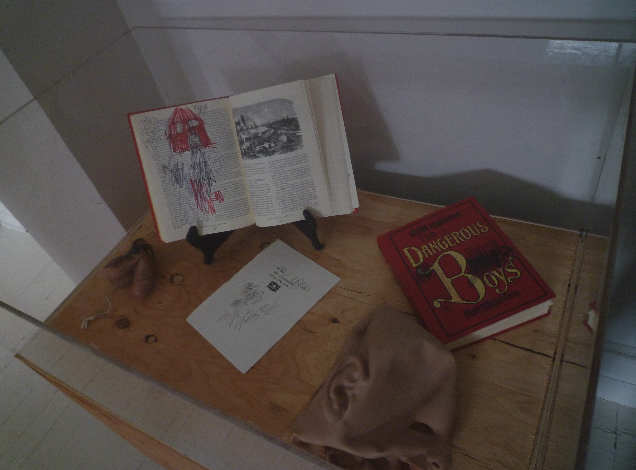
Last week saw the release of Howl, a film about the obscenity trial surrounding the release of Allen Ginsberg's poem of the same name in 1957, and the latest venture by actor and now general all round renaissance man James Franco. Dulcie and I went to see it at the Cornerhouse, and though I was apprehensive at first, we both really enjoyed the eclectic mix of animation and poetry recital recreations. It seems Franco has come a long way since portraying the son of Spiderman's arch nemesis; in the past year alone Franco has been Academy Award nominated for one of his numerous film roles, released a book of short stories, as well as entering the art world with gallery shows in Berlin and Beverly Hills, the latter a collaboration with Gus Vant Sant, who he worked with on the film Milk, at no less than the monolith that is Gagosian Gallery. In fact, his wikipedia entry labels him as 'actor, film director, screenwriter, film producer, author, painter and performance artist', as well as pointing out his current study for a Ph.D at Yale University. It seems there is nothing the man can't do.

In branching out into so many different areas of the creative industries Franco proves an interesting case. Many writers have dabbled in the film industry and actors and musicians are renowned for exchanging roles. The real question is whether they achieve any real success, and whether there acceptance is affected by their fame in a different field. Elvis Presley wasn't taking that seriously as an actor, nor Joaquin Phoenix as rapper. Today the crossover seems to be becoming a more popular phenomenon, with even Lady Gaga being heralded as a performance artist. Is Franco to be taken seriously as an artist, then, or does his rising to fame as a Hollywood actor negate any artistic offering he may wish to make as negligible, a mere vanity project? It is certainly an interesting question to consider in a world which claims to be post-canon, the boundaries of high and low long removed since the emergence of a so called postmodern age.


(James Franco, The Dangerous Book Four Boys, Peres Projects Berlin 2011)

Perhaps Franco is a Warhol for our times, refusing to be held down to one field or another but moving between roles with seemingly unending creative energy. Or perhaps he is simply making the most of a famous name, exhibiting at a gallery that is not shy to representing artists whose reputation often eclipses their art work - the late Dash Snow, Terence Koh, a some time Lady Gaga collaborator. Either way the fact is that he is doing these things, his book has been published, receiving not all that bad press along the way, and he is showing in the world's largest commercial art gallery. There will always be cynics, but who are we to judge? and is it ever possible to analyse art (or literature) objectively, unaffected by our knowledge of its author?

Friday, 18 February 2011

AND...


As I mentioned yesterday, today was the first day of a self publishing workshop I'm involved in as part of our practical unit at college. In the morning we discussed a little about what the artist book might be and the possible importance medium can have in disseminating an idea, followed by a practical session in the afternoon. In twos or threes we had to produce a publication with limited means - paper, long arm stapler, thread, photocopier - using what we could find from the library books surrounding us as source material. In my pair we settled on the idea of creating a kind of fictional encyclopaedia, with images selected from a variety of different books of art, theory, literature and history. Due to the seemingly arbitrary nature of the images and the titles we gave to each entry the encyclopaedia is not essentially intended to impart knowledge, but is more a reflection on the way in which knowledge and concepts of history and value are constructed.


Making a dummy...


The finished article...

Thursday, 17 February 2011

Studio notes


Just a little documentation of my current work in progress... To give a little background to the work, I am mainly concerned with the idea of the in-between space, and have been looking at these kinds of places that occur often on the periphery of urban spaces. I am having issues with display methods, it seems to be one of the major stumbling blocks right now in terms of my work's progression, other than that I'm feeling fairly positive about the direction it is taking, and the relations being produced between the images once they are in place on the wall.

Tomorrow is the first of a five day, bi-weekly self-publishing project which I am now really looking forward to starting, I feel more and more that the work could exist particularly well in book form. The idea of a book being placeless is a concept that particularly appeals to me in relation to this body of work, a potential for the work to be distributed and received simultaneously in various locations outside of the singular space of the studio.

Saturday, 5 February 2011

Zidane


I finally got round to watching Douglas Gordon and Phillipe Parreno's Zidane: A 21st Century Portrait this evening. The film follows legendary footballer Zidane for the duration of a match against Villareal, with 17 cameras tracking his every move. Edited together with the varying footage and soundtracked beautifully by Mogwai, the film is first and foremost a treat to watch and at times moving. Michael Fried has discussed this film in relation to his interests in Diderot's notion of absorption, which argues that the most true form of portrait shows the subject completely absorbed in their actions, unaware of being observed. As he points out this film does that majestically, whilst also posing interesting questions due to Zidane's immediate surroundings: he is obviously aware of the magnitude of the people watching him (in the stadium but also around the world on television), yet his ability to remain absorbed completely in the task at hand never wavers. It is this aspect that I found most interesting, the way it allows us to reflect on the nature of the image today, its mass circulation and the spectacle of the sport itself, a truly global sport of which Zidane was a global icon (albeit a tragic one...)

Thursday, 20 January 2011

Non-place


I went to see the newly opened Gabriel Orozco exhibition at Tate Modern today, a newly opened show surveying the Mexican artist's two decades of work in sculpture, painting and photography. These two photos stuck with me in terms of their capturing of a space in between places, something of a major concern in my own work at the moment.

(Top: An Island Within an Island
Bottom: From One Roof to Another)

Tuesday, 18 January 2011

Gallery talk


Some point soon I'm hoping to make a trip to Southend-on-Sea to visit the Focal Point Gallery. Founded in 2009 with support from the Art Council, it's one of numerous similarly funded galleries that are popping up around the country that is putting on relevant, exciting exhibitions, bringing contemporary art to an audience outside of London in a genuinely positive way. Their current show Anti-Photography features a number of big names, from Walead Beshty to Wolfgang Tillmans and Ed Ruscha, reflecting on the nature of the photographic image. Along with the likes of Nottingham Contemporary, who hosted the recent British Art Show 7 and an exhibition of David Hockney's work, and the forthcoming Hepworth gallery in Wakefield, a mix of good architecture and a programme of compelling exhibitions are coming together to prove that perhaps the arts can thrive in spite of the cuts.

Monday, 17 January 2011

Architectural forms


The Atlas Group is a really interesting archival project worth checking out. Founded by Walid Raad, it is a fictional collective devoted to researching and documenting the contemporary history of Lebanon. These images form part of a series by the group to document buildings of architectural, political, technological or national significance in Beirut.

Thursday, 16 December 2010

Art as book


Today I learnt the next term I will be working on a project that centres around publication as a means of artistic production, run by these people at Byam Shaw, so thought I'd post a few examples from the master of the artist book, Ed Ruscha. Not sure how this fits in with my current work on the photograph as an object on the wall, but we shall see.

Monday, 13 December 2010

Absorption


All photographs Jeff Wall, from top: Passerby; Untitled (Forest); Untitled (Night); The Burrow.