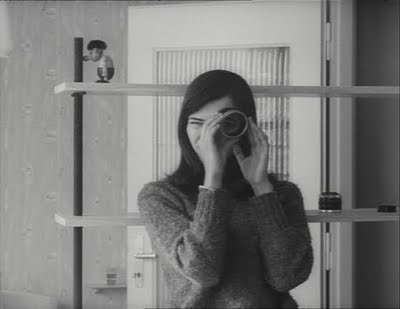
French playwright Paul Javal is hired by American producer Jack Prokosch to save his ailing production of Homer's Odyssey, where filming - directed by Fritz Lang as himself - has been halted at Cinecittà studios in Rome. Upon accepting the job Javal's life starts to mirror that of the film's hero, with the pressures of commercial constraints (embodied by Prokosch) leading to him becoming slowly estranged from his wife Camille (Brigit Bardot). As well as an examination of the collapsing marriage of the lead characters, the film can be described as being essentially about cinema, with Godard critiquing the Hollywood model and employing numerous instances of reference and self-reference - Fritz Lang being cast as himself, Godard playing the part of Lang's assistant, Bardot reading a book on Fritz Lang, and of course the obvious mirroring of Ulysses' estrangement with his wife with Javal's estrangement with Camille. The opening shot in particular draws our attention to this explicitly, in which the mechanisms of cinema are laid bare and we see Godard's camera crew filming a tracking shot of Prokosch's assistant, the camera moving ever closer to the screen before directing itself directly at the viewer, thus implicating us as viewer or spectator in the film.
It's been a busy few weeks, trying to further my work in the studio around trips home and late night shifts at Tesco. I've been shooting medium format on a regular basis, a format I had always been hesitant about but have found myself embracing, and I've found my work coming back to a relationship with cinema that I began to explore last year. As well as this I've been slowly working myself through Jean-Luc Godard's extensive back catalogue (I've got a long way to go), this weekend watching Une femme est une femme and Pierrot Le Fou. In the meantime I've also been reminding myself how good this album is:
Should also remind anyone that's interested about my website which is now over a month old, although still a work in progress... www.jianweilim.co.uk
Lately I've been exploring the relationship between photography and film, and I've become increasingly interested in the gaze, or glance, and its cinematic as well as photographic effect. Last week I made a book that took one second of footage from David Lynch's Mullholland Drive and presented it as twenty-four still images, or frames. I chose the scene at first because of the way the film is deals with classic Hollywood cliches, the tragic Hollywood dream, so to speak. As I've been reading more around the subject I've been finding more and more significance within the short clip I used, which I have now remade into a film using the stills I took from the original. Edward Branigan writes that "glances are so important to narrating a story world that the only glance that is generally avoided is a glance into the lens of the camera. A look into the camera breaks the diegesis because it makes the conventional reverse shot or eyeline match impossible". What I took from this is that a glance directly into the lens of the camera breaks the suspension of reality that the audience undergoes when watching a film (specifically in a cinema, the context of the gallery space is different). This suspension of reality is important, it is the forgetting of ourself and our surroundings that allow us to be truly absorbed into the world of the film, and so a direct glance from someone on screen would remind us of the fact that we are in fact watching the film. One particular scene sprung to mind when I was thinking about this, specifically for the way it does exactly what cinematic convention says not to - the actress on screen confronts the lens directly, thus breaking the illusion the film has set up. The scene in question is from the end of Jean-Luc Godard's "A bout de Souffle":
The effect of this shot employed by Godard is quite startling, there is a sense of the absorptive experience being broken, of being addressed directly as Jean Seberg's gaze bores into the lens, before she turns her head and the film draws to a close. It is as if Godard is addressing cinematic convention, reminding us just before we leave the cinema that we are in fact in the cinema watching actors and actresses on screen. It's an aside, in the same way Shakespearean soliloquies would often address the audience directly, engaging with them so as to let them know they have an awareness of their presence. Whatever his intentions it succeeds in raising questions about the cinema and the act of viewing - the role of spectator and the sense of forgetting one submits to when watching a film.